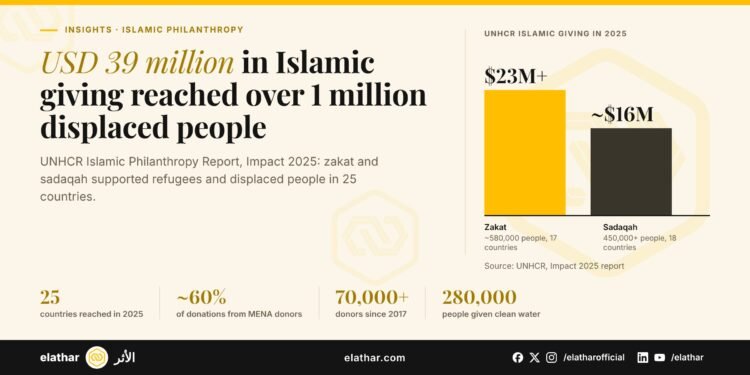
UNHCR, the UN Refugee Agency, raised USD 39 million in zakat and sadaqah in 2025 and used it to support more than 1 million refugees and internally displaced people in 25 countries, according to its Islamic Philanthropy Annual Report, Impact 2025, launched on 27 February 2026. Nearly 60% of donations came from donors based in the Middle East and North Africa, according to UNHCR.
What is UNHCR’s Islamic Philanthropy Report?
It is UNHCR’s annual report on the zakat and sadaqah funds it manages and their impact on refugees and displaced people. The Impact 2025 edition covers the year 2025. It was launched in Dubai on 27 February 2026 and is the most recent edition as of October 2026.
Since 2017, UNHCR has run the Refugee Zakat Fund under a 100% zakat distribution policy, backed by 18 fatwas and scholarly endorsements. The Global Islamic Fund for Refugees was set up in 2022 with the Islamic Development Bank and the Islamic Solidarity Fund for Development.
What are the key figures?
| Indicator (2025) | Figure |
|---|---|
| Total Islamic giving | USD 39 million |
| Zakat | Over USD 23 million, for nearly 580,000 eligible refugees and displaced people in 17 countries |
| Sadaqah | Almost USD 16 million, for more than 450,000 people in 18 countries |
| Total people supported | More than 1 million displaced people in 25 countries |
| Share from donors in the Middle East and North Africa | Nearly 60% |
| Donors since 2017 | More than 70,000 |
- Wider reach: the program expanded to four new countries in 2025.
- Sadaqah jariyah: water projects in Bangladesh gave 280,000 people access to clean water.
- Since 2017, the program has reached more than 9.9 million people in 36 countries, according to the report’s executive summary.
What does this mean for NGOs and donors in the Arab world?
Arab donors are driving this giving. With nearly 60% of donations coming from the Middle East and North Africa, the region is not only a recipient of aid but a major funder of humanitarian work. That gives Arab donors every reason to ask for clear impact reporting.
Religious transparency builds trust. A 100% zakat distribution policy, published fatwas, and beneficiary numbers by country are practices that Arab NGOs collecting zakat can adopt to reassure their donors.
Impact is measured, not claimed. The report separates zakat and sadaqah by amount, beneficiaries and countries. That level of detail is a useful model for any organization that wants to move from talking about “doing good” to figures that can be checked.
Sadaqah jariyah opens the door to long-term projects. Water projects reaching 280,000 people show how sadaqah can fund lasting infrastructure, not only emergency aid.
Frequently asked questions
Who published the report?
UNHCR, the UN Refugee Agency, through its Islamic Philanthropy program and the Refugee Zakat Fund.
How much did UNHCR raise in zakat and sadaqah in 2025?
USD 39 million: over USD 23 million in zakat and almost USD 16 million in sadaqah.
Does all zakat reach eligible people?
UNHCR says it applies a 100% zakat distribution policy to eligible refugees and displaced people.
What period does the report cover?
It covers 2025 and was launched on 27 February 2026.