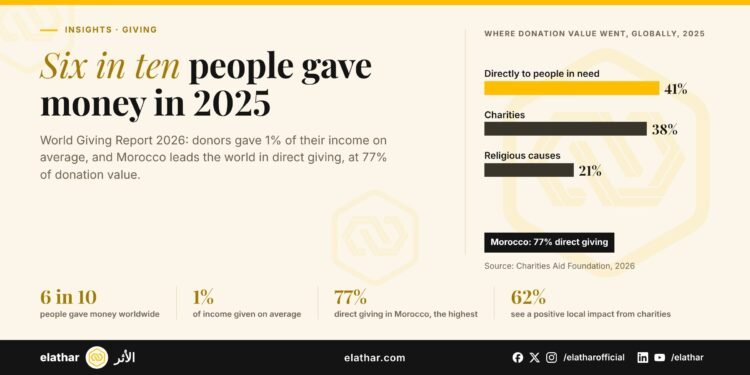
Six in ten people worldwide gave money to good causes in 2025, donating on average 1% of their income, according to the World Giving Report 2026: Donor Insights, published by the Charities Aid Foundation (CAF). Morocco stands out: 77% of the value of donations there went directly to people in need, the highest share of any country covered, according to the World Giving Report website.
What is the World Giving Report 2026?
The report is published by the Charities Aid Foundation, a UK-based charity. The 2026 Donor Insights edition is the second year of the report in its current form. It covers giving during 2025 across 105 countries and was published in June 2026.
A companion Charity Insights study looks at the charities themselves. As of October 2026, this is the most recent edition of the report.
What are the key findings?
| Indicator (giving in 2025) | Result |
|---|---|
| People who gave money, globally | Six in ten |
| Average donation as a share of income | 1% globally, 1.6% in Africa, 0.6% in Europe |
| Gave directly to people in need | 36% |
| Gave to charities | 34% |
| Gave to religious causes | About 23% |
| Share of donation value, globally | 41% direct, 38% charities, 21% religious |
- Morocco leads in direct giving: 77% of donation value in Morocco went directly to people in need, compared with 10% in the Netherlands.
- Local belonging lifts giving: in countries where more than 80% of people feel a strong sense of local belonging, average giving reached 1.7% of income, against 0.6% where fewer than half do.
- Donors who cite two or more social influences give almost twice as much as those who cite none, according to the Charities Aid Foundation.
- Trust in local impact: 62% of people worldwide see a positive local impact from charities, rising to 75% in Africa.
- 40% say their government encourages giving, and children are among the top five causes on every continent.
What does this mean for Arab NGOs?
An NGO’s first competitor is direct giving. When 77% of donation value in Morocco goes straight to people in need, donors do not need an NGO to give. Organizations have to show what they add: reaching people donors cannot see, continuity over time, and measured results.
Show impact in the neighborhood, not in slogans. Trust follows visible local impact, and local belonging lifts giving. Simple figures about the people helped in a district or city persuade more than general talk about doing good.
Giving is social. People give more when they see others give. Peer-to-peer campaigns, collective giving in families or workplaces, and donor testimonials are proven ways to lift donation value.
Religious giving is a major channel. A fifth of donation value worldwide flows through religious routes. In the Arab region, where zakat and sadaqah are part of daily life, organizations earn trust when they explain how zakat funds are spent and who benefits.
Frequently asked questions
Who publishes the World Giving Report?
The Charities Aid Foundation (CAF), a charity based in the United Kingdom.
What period does the data cover?
The 2026 edition covers giving during 2025.
Where does Morocco stand in the report?
Morocco has the highest share of direct giving in the world: 77% of donation value goes straight to people in need.
Is this the most recent edition?
Yes. As of October 2026, the 2026 edition is the latest.