
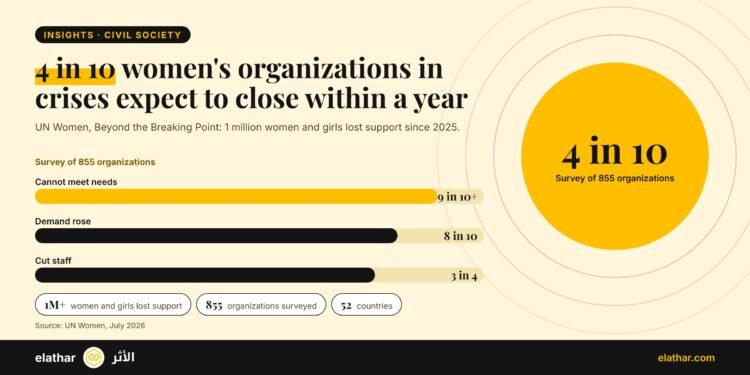
Four in 10 women-led and women’s rights organizations working in humanitarian crises expect to close within the next 12 months, and at least 1 million women and girls have lost access to critical services since January 2025, according to UN Women’s report Beyond the Breaking Point, presented in Geneva on 10 July 2026.
The report surveyed 855 organizations in 52 countries. Its findings concern every civil society organization that depends on international humanitarian funding, including many in the Arab region.
About the report
| Publisher | UN Women |
| Released | 10 July 2026 |
| Title | Beyond the Breaking Point: The continuing impact of funding cuts on women’s organizations in humanitarian settings |
| Data covered | Global survey of 855 mainly local and national women-led and women’s rights organizations in 52 countries and contexts, plus interviews |
| Latest edition? | Yes. It follows UN Women’s 2025 assessment, At a Breaking Point. |
Key findings
- At least 1 million women and girls have lost access to critical services and support since January 2025, according to UN Women.
- 8 in 10 organizations have seen demand for their services rise since January 2025, and more than 9 in 10 say they cannot meet current levels of need.
- Three quarters have cut staff, nearly 2 in 3 say staff are working without pay, and almost half report rising burnout in their teams.
- 4 in 10 expect to close within the next 12 months, UN Women reports.
- Nearly 2 in 3 say safe spaces and gender-based violence services have been significantly reduced or are no longer available.
- 1 in 5 organizations has suspended work on women’s leadership and gender equality, and more than half see fewer women taking part in community leadership and local decision-making, according to the press briefing.
What the surveyed organizations report, according to UN Women:
| Finding | Share of organizations |
|---|---|
| Cannot meet current needs | More than 9 in 10 |
| Saw demand rise since January 2025 | 8 in 10 |
| Cut staff | 3 in 4 |
| Staff working without pay | Nearly 2 in 3 |
| Expect to close within 12 months | 4 in 10 |
What the report means for civil society organizations in the Arab region
- Diversify funding before the cut comes. Organizations that rely on one or two international donors are the most exposed. Local giving, zakat and waqf, foundations and earned income can reduce that dependence.
- Protect the team. Unpaid work and burnout are not sustainable. Boards and funders should treat staff costs as part of the mission, not overhead.
- Document unmet need. When more than 9 in 10 organizations cannot meet demand, data on who was turned away is the strongest argument for new funding.
- Build coalitions. Shared services, joint proposals and networks help smaller organizations survive and keep women’s voices in local decision-making.
The picture is consistent with the wider sector: see our summary of CAF’s Charity Insights 2026, where 61% of charities name financial sustainability as their top challenge.
📥 Download the full report
UN Women publishes the full report and a summary free of charge. The report is published by UN Women, not by Elathar.
FAQ
At least 1 million since January 2025, according to UN Women.
4 in 10 of the organizations surveyed expect to close within the next 12 months.
855 mainly local and national women-led and women’s rights organizations working in 52 countries and contexts.
Immediate funding for women’s organizations, multi-year support so they can plan and retain staff, and their participation in humanitarian decision-making.
Sources
- UN Women: Aid cuts decimate services for women and girls, press briefing, 10 July 2026
- UN Women: Beyond the Breaking Point, publication page

