When visitors arrive at your site, their first concern is whether their information will remain safe— SSLs certificate provides that assurance. This digital credential proves your website’s identity and enables encrypted TLS connections. It transforms vulnerable data into coded information during transmission.The primary job of this technology is encryption. It scrambles sensitive details like credit card numbers and login credentials. Hackers who intercept the connection cannot read this scrambled data.
Beyond hiding information, SSLs certificate authenticates your business. It confirms to customers they’ve reached your legitimate site, not a fraudulent copy. This verification fights phishing scams that target brand reputation.
Modern browsers actively protect users with clear warnings. Sites without HTTPS display “Not Secure” alerts. These notices damage credibility and can increase visitor departure rates.
Search engines reward secure sites with better visibility. Google uses HTTPS as a positive ranking factor. Proper implementation can lift your search results position.
For businesses handling payments, SSLs certificate is often mandatory. Standards like PCI DSS require encryption for compliance. It helps meet data protection regulations for customer details.
Visual trust symbols create immediate psychological comfort. The padlock icon and “HTTPS” prefix signal safety. Customers feel more confident submitting forms or making purchases.
Every form submission or user session without protection is vulnerable. Interception risks make this an unacceptable gap for any serious website. The absence of encryption exposes personal and company data.
Investing in an SSL certificate is a foundational business decision. It safeguards customer details and your company’s integrity. This step builds lasting trust and supports your online success.
Understanding SSL/TLS: The Technology Behind the Lock
Behind every secure website connection lies a complex technical foundation known as SSL/TLS encryption. These protocols work silently to protect your sensitive information. They create a trusted link between your device and a web server.
SSL stands for Secure Sockets Layer. TLS means Transport Layer Security. Most connections today use the more advanced TLS protocol.
The term “SSL” remains common in everyday language. This layer security system authenticates websites and scrambles data. It prevents unauthorized access during transmission.
How the SSL Handshake Creates a Secure Connection
Establishing a secure connection begins with an automated handshake. This process happens in milliseconds when you visit a protected site. Your browser and the server exchange critical information.
First, the browser requests the site’s SSLs certificate. This contains the server’s public key. The browser uses this to verify the server’s identity.
The handshake involves three types of cryptographic keys. These are public, private, and session keys. The public and private keys work together to generate a unique session key.
This session key then encrypts all subsequent data exchanges. Symmetric encryption with this key is fast and efficient. It protects everything from login details to payment information.
Critical Information Contained in Every SSL Certificate
Every SSLs certificate holds specific identifying details. This information allows browsers to validate the website’s authenticity. It forms the basis of the trust you see as a padlock icon.
The certificate always includes the validated domain name. It lists the issuing Certificate Authority (CA). Validity dates show when the certificate was issued and when it expires.
The public key is a crucial component within the certificate. It is mathematically paired with a private key stored securely on the web server. Data encrypted with one key can only be decrypted with the other.
The CA’s digital signature proves the certificate is genuine. It confirms the information hasn’t been altered or forged. Browsers check this signature during the validation process.
Additional details may include organization name and associated subdomains. The expiration date ensures regular renewal and maintains security standards. This cycle allows for re-verification of domain ownership.
Understanding this technical foundation helps explain the padlock symbol. It represents an automated, complex process. This system works constantly to guard your online data.
The Three Levels of SSL Validation: DV, OV, and EV
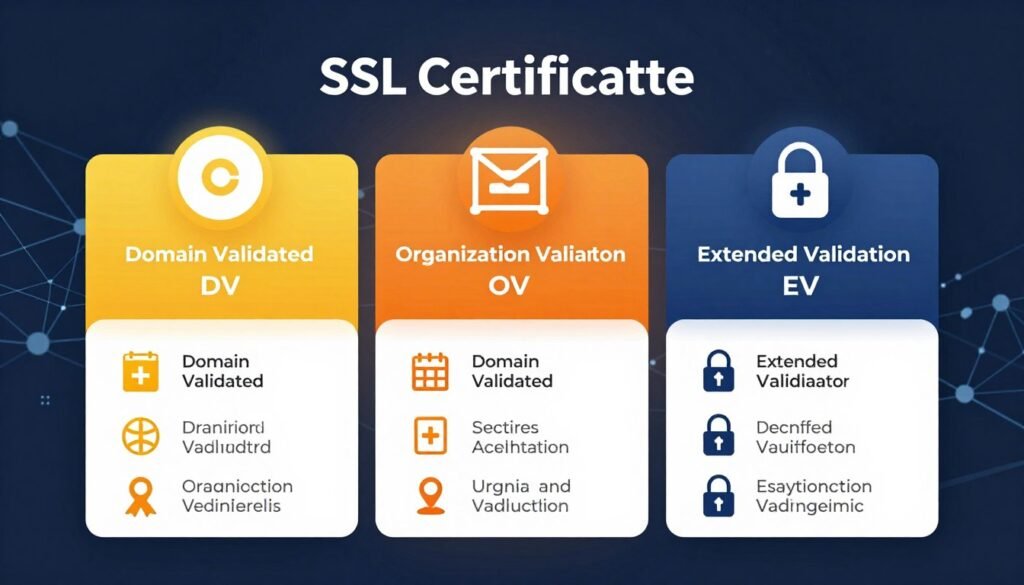
Not all SSLs certificates are created equal—their validation level determines how much trust they convey to your visitors. Certificate Authorities categorize certificates by how thoroughly they vet applicants before issuance. This vetting process directly impacts the trust signals displayed in browsers.
You can choose from three main validation tiers. Each tier offers different benefits for security and credibility. Your website’s purpose should guide your selection.
Domain Validation (DV): Fast and Affordable
Domain Validation represents the most basic and accessible level. The Certificate Authority verifies you control the domain through a simple email check or DNS record. This quick process often results in a certificate issued within minutes.
DV certificates provide essential encryption without business identity verification. They are ideal for personal blogs, portfolio sites, or test servers. The primary need here is basic data protection during transmission.
You get the padlock icon and HTTPS protocol with this option. However, no organizational details appear in the certificate. This makes DV perfect when encryption is the sole requirement.
Organization Validation (OV): Establishing Business Credibility
Organization Validation requires more thorough verification of your business. The Certificate Authority checks your company’s legal existence and operational status. They examine official registration documents during this process.
OV certificates display your verified organization name within certificate details. This offers higher credibility for commercial websites and e-commerce platforms. Customers can see your legitimate business information.
The validation typically takes one to three business days. Manual checks by the CA’s team ensure accuracy. This option balances trust with reasonable issuance time.
Extended Validation (EV): The Highest Standard of Trust
Extended Validation involves the most rigorous verification process available. The Certificate Authority performs comprehensive checks on legal, physical, and operational existence. They cross-reference corporate documents against independent databases.
EV certificates trigger the most prominent browser trust indicators. They historically turned address bars green and displayed the company name prominently. This signals the highest level of trust to visitors.
Financial institutions and large corporations often choose this validation. Any site handling highly sensitive transactions benefits from EV. It maximizes user confidence and meets strict assurance requirements.
Selecting the right validation level is a strategic decision. Choose DV for basic encryption needs on simple sites. Opt for OV to establish business credibility with verified details.
Consider EV when you need maximum trust and brand assurance. Your choice should align with your website’s purpose and user expectations.
Choosing the Right SSL Certificate Type for Your Site
Selecting the appropriate SSLs certificate involves more than just validation level. It requires matching the certificate type to your website’s architecture. Your choice determines how many domains and subdomains you can secure with one purchase.
This decision impacts your server configuration and budget. Planning for future growth is essential when evaluating options. The right type simplifies management and controls costs.
Single Domain SSL: Protecting One Primary Website
A Single Domain SSL certificate secures one fully qualified domain name. This includes both the www and non-www versions of your address. It is the most common type for standard business websites.
This option is perfect for portfolios, blogs, or simple company sites. You get basic encryption for a single primary domain. The certificate covers yourdomain.com and www.yourdomain.com automatically.
Basic and Premium SSL certificates often fall into this category. Premium versions may secure up to three separate domains. Enterprise EV SSL certificates also typically protect one domain.
Wildcard SSL: Securing Your Domain and All Subdomains
A Wildcard SSL certificate uses an asterisk in the domain field. It secures your main domain and unlimited subdomains. This type is identified as *.yourdomain.com during setup.
Wildcards are cost-effective for sites with complex subdomain structures. They protect blog.yourdomain.com, shop.yourdomain.com, and client.yourdomain.com. Each new subdomain receives automatic protection.
This option reduces administrative work on your web server. You manage one certificate instead of many individual ones. It is ideal for development environments and growing businesses.
Multi-Domain (UCC/SAN) SSL: One Certificate for Multiple Websites
Multi-Domain certificates secure completely different domain names. They are also called UCC or SAN certificates. This type consolidates management for multiple websites under one certificate.
This solution works well for businesses managing several distinct brands. It can protect yourdomain.com, yourbrand.net, and yourservice.co.uk. Each domain receives full encryption from a single certificate.
UCC/SAN SSL certificates support multiple domains and subdomains. Enterprise EV UCC/SAN versions offer the highest validation for complex setups. They provide maximum trust across your entire digital portfolio.
Your certificate type choice affects long-term expenses and server management. Consider both current needs and future expansion plans. The right selection ensures efficient security for your online presence.
Key Features to Compare When Buying SSLs
Before purchasing an SSL certificate, savvy buyers examine several critical technical and financial details. The cheapest option often lacks important protections that matter for business security. You need to evaluate features that impact both immediate costs and long-term value.
Look beyond the initial price tag when comparing providers. The right choice balances protection, flexibility, and support. These factors determine your website’s security posture and administrative burden.
Warranty Amount and Financial Protection
The warranty represents a financial guarantee from the Certificate Authority. It covers potential losses if a security failure occurs due to CA error. This protection matters for businesses handling sensitive customer data.
Basic Domain Validation certificates typically offer around $10,000 in coverage. Extended Validation options provide up to $1.75 million or more. The warranty amount reflects the validation level and risk assessment.
Higher warranty amounts signal greater confidence in the certificate’s integrity. They also offer more substantial financial protection for your customers. Consider this coverage when handling transactions or personal information.
Encryption Strength: RSA vs. ECC
Encryption strength depends on the algorithm and key length used. RSA 2048-bit remains the current industry standard for security. It provides robust protection for most website applications.
Elliptic Curve Cryptography (ECC) offers stronger security with smaller key sizes. This technology delivers faster performance while maintaining high protection levels. Many modern servers now support ECC certificates.
Check whether your server software works with newer encryption methods. Compatibility ensures smooth implementation without technical issues. The right choice balances security needs with system capabilities.
Server Licenses and Reissue Policies
Server licenses determine how many installations you can create. Unlimited licenses are valuable for complex hosting environments. They allow installation across load-balanced servers without additional costs.
Reissue policies provide administrative flexibility for certificate management. Unlimited free reissues let you regenerate certificates when needed. This covers server changes, key compromises, or domain list updates.
Always verify browser and mobile device compatibility before purchase. The validation process should align with your timeline requirements. Some providers offer five-minute issuance for Domain Validation certificates.
Consider the standard one-year validity period for enhanced security. Comparing these features reveals the best long-term value for your investment. The right certificate supports both protection and operational efficiency.
How to Determine Your Website’s SSL Requirements
Finding the right SSL certificate begins with a thorough assessment of your specific website needs and business context. A proper evaluation prevents overspending on unnecessary features. It also avoids purchasing inadequate protection that leaves your site vulnerable.
Start by auditing your technical environment completely. List every domain and subdomain needing HTTPS encryption. This includes www, mail, shop, and app addresses that must function securely.
Evaluate your website’s fundamental nature and purpose. A static blog typically needs only Domain Validation. An e-commerce store collecting payments benefits from Organization Validation.
Banking and financial services often require Extended Validation certificates. Your website type directly influences the appropriate validation level. Match the certificate to your actual operational needs.
Consider your industry’s regulatory landscape carefully. Standards like PCI DSS, HIPAA, or GDPR may impose specific requirements. These regulations often dictate encryption standards and validation levels.
Financial institutions in the EU may need Qualified Website Authentication Certificates. Always check with your IT department for compliance adequacy. Regulatory needs should guide your certificate selection.
Assess your brand’s requirement for visible trust signals. Customer-facing businesses in competitive markets need heightened credibility. Organization Validation or Extended Validation certificates deliver this advantage.
The right certificate strengthens customer confidence during transactions. It provides visual assurance through browser indicators. This trust factor impacts conversion rates directly.
Analyze your company’s organizational structure thoroughly. A single small business has different needs than a large enterprise. Multiple brands and domains require more comprehensive solutions.
Factor in your team’s technical expertise realistically. Wildcard and Multi-Domain certificates offer management convenience. However, they demand precise configuration during installation.
Plan for future growth from the beginning. Anticipate adding subdomains or new sites within the certificate’s validity period. A Wildcard or Multi-Domain certificate accommodates this expansion.
Review your web hosting platform’s specifications carefully. Ensure compatibility with your chosen certificate type and encryption algorithm. Both RSA and ECC options should work seamlessly with your server.
Consider certificate duration and renewal requirements. Most certificates last one year for enhanced security. Factor renewal processes into your long-term management strategy.
Answering these questions creates a clear specification document. This guide leads you to the perfect SSL certificate for your situation. You achieve optimal balance between security, trust, compliance, and cost.
The assessment process ensures your investment delivers maximum value. Your website receives appropriate protection matching its specific requirements. This strategic approach supports both immediate needs and future growth.
A Detailed Look at SSL Certificate Costs and Value
Understanding SSLs certificate pricing requires looking beyond the initial purchase price to evaluate long-term value and protection. The cost reflects multiple factors that determine security effectiveness. Your investment should match your website’s specific needs.
Certificate pricing is not arbitrary. It reflects the validation rigor, warranty level, and included features. The issuing Certificate Authority’s reputation also influences the price.
Domain Validation certificates are the most affordable option. They often range from free to around $100 per year. Basic SSL (DV) certificates start from $36.75 annually.
Organization Validation certificates carry a moderate price premium. The manual validation process justifies this cost. High Assurance SSL (OV) options begin at $48.40 per year.
Extended Validation certificates represent the highest investment tier. Extensive vetting and maximum warranty levels justify the price. Enterprise EV SSL certificates start from $239.50 annually.
Certificate type significantly impacts your final cost. A Single Domain certificate provides the baseline protection. Wildcard SSL (OV) certificates secure unlimited subdomains for $224.25 per year.
Multi-Domain solutions offer consolidated management. UCC/SAN SSL (OV) certificates begin at $141.60 yearly. Enterprise EV UCC/SAN SSL certificates provide maximum validation for $319.20 annually.
The value of a certificate extends far beyond its price tag. Financial warranty protection offers important security. Strong browser recognition builds immediate visitor trust.
Quality customer support from your provider matters during installation. These elements combine to create comprehensive protection. Your business deserves this complete security package.
Be wary of hidden costs that can increase expenses. Some providers charge fees for reissuing certificates. Adding SANs post-issuance may involve extra charges.
Dedicated support sometimes carries additional costs. Look for providers offering unlimited reissues and server licenses. This approach controls long-term management expenses.
Consider the total cost of ownership over multiple years. Renewal rates often differ from promotional first-year prices. Factor this into your budgeting process.
Investing in a properly validated certificate prevents costly security incidents. It protects against loss of customer trust and search ranking damage. This investment offers a high return for your company.
The goal is finding the optimal intersection of cost and value. Pay for the security and trust your business genuinely needs. Avoid both over-engineering and under-protecting your site.
Your SSL certificate represents a strategic business decision. The right choice balances protection with budget considerations. This approach supports sustainable online growth.
The Step-by-Step Process to Buy Your SSL Certificate
Acquiring an SSL certificate follows a clear, step-by-step procedure that ensures proper implementation from start to finish. This systematic approach prevents common installation errors. It also guarantees your web server receives proper encryption.
Generating a Certificate Signing Request (CSR)
The first technical action happens on your web server. You must generate a Certificate Signing Request. This process creates two cryptographic keys.
Your server produces a private key that stays completely secret. It also creates a public key embedded within the CSR. The CSR contains essential identifying information for your domain.
This includes your common name, which is your full website address. Organization details and location data are also included. The Certificate Authority uses this to create your custom certificate.
Selecting a Provider and Completing Your Order
Next, research reputable SSLs providers or Certificate Authorities. Compare them using the features discussed earlier. Price, warranty, validation level, and support matter most.
Choose your specific certificate product during checkout. Provide accurate contact and billing information. You will then paste your CSR into the provider’s order form.
This submits your official request to the CA. Payment processing initiates the validation phase. The type of certificate determines what happens next.
Domain Validation may complete in minutes via email. Organization or Extended Validation requires document submission. Business paperwork proves your legal existence.
Once approved, your SSLs certificate is issued. The CA delivers it via email or account dashboard. You receive the certificate file and intermediate CA bundles.
Install these files on your original web server. Follow your hosting provider’s specific instructions. Configuration must match your initial CSR details.
Finally, test the installation using online SSLs checkers. Verify the certificate works correctly. Ensure all major browsers recognize and trust it.
This complete process secures your website connection properly. Each step builds upon the previous one. Following the sequence guarantees a smooth implementation.
What to Expect During SSL Validation and Issuance
Getting your SSL certificate issued involves a verification journey that varies dramatically based on the type you chose. This phase transforms your purchase into active website protection. The validation process establishes trust between your business and visitors.
Each certificate level follows a distinct verification path. Domain Validation offers the fastest route to encryption. Organization and Extended Validation require deeper business checks.
Navigating the Documentation Process for OV and EV Certs
Organization Validation requires submitting official business documents. The Certificate Authority’s team manually reviews this information. They verify your legal existence and operational status.
Common documents include business licenses and incorporation papers. Third-party directory listings may also serve as proof. Accuracy in your submission directly impacts approval time.
You might need phone verification using a listed business number. This confirms the contact information matches public records. Prompt responses to CA inquiries keep the process moving.
Extended Validation demands the most comprehensive documentation. Validators examine legal identity, physical address, and operational existence. They also confirm the requester’s authority to act for the organization.
EV validation often involves notarized letters and government records. Cross-referencing with independent databases adds another layer. This thorough approach ensures maximum trustworthiness.
Gather correct documents before starting the validation process. A recent business license and utility bill for address verification help. Proactive preparation significantly speeds up issuance.
Timelines: From Minutes for DV to Days for EV
Domain Validation certificates can be issued in minutes. Automated systems verify domain control through email or DNS records. This makes DV ideal for immediate encryption needs.
You prove ownership by responding to an email. Creating a specific DNS record is another common method. The certificate issued notification arrives quickly after confirmation.
Organization Validation typically takes one to three business days. Manual document review causes this longer timeline. The CA’s current workload also affects processing time.
Extended Validation requires three to ten business days for completion. The comprehensive checks justify this extended period. Planning for this timeline is crucial for project schedules.
Your certificate type determines the waiting time. DV offers near-instantaneous issuance for basic protection. OV provides business verification within a few days.
EV delivers the highest trust after thorough validation. Understanding these timelines helps manage expectations. Choose the level that balances your needs with available time.
Real Customer Experiences: Insights from SSLs.com Users
Customer reviews cut through marketing claims to reveal how an SSL certificate provider performs during purchase, validation, and support. These firsthand accounts offer a transparent look at the actual user journey.
They highlight what works well and where you might encounter friction. This insight is invaluable for making an informed decision for your web site.

Positive Feedback on Support, Price, and Ease of Use
Many users consistently praise the accessibility and quality of customer support. Reviews frequently mention 24/7 live chat as a standout feature.
Customers report receiving “excellent support” that guides them through technical server configuration. This professional assistance resolves installation issues quickly.
Competitive pricing is another major positive highlighted in user feedback. Shoppers often find these certificates offer “great value” compared to other providers. The term “affordable” appears regularly in authentic reviews.
The purchasing process itself receives compliments for being straightforward. Users describe the website interface as “easy to operate.” This simplicity reduces friction from the moment you decide to buy.
One reviewer summed it up as “very professional, easy and affordable.” This combination builds immediate confidence in the service.
Common Challenges and How Support Resolves Them
Authentic reviews also shed light on common points of confusion. The validation process for OV and EV certificates is a frequent topic.
Some users expect instant issuance, similar to a Domain Validation certificate. The reality of manual checks can lead to initial frustration.
The disconnect between expectation and timeline is a key challenge. The 1-3 day process for Organization Validation requires patience. Submitting correct business documentation can also cause delays.
Phone callback verification sometimes stalls the process. Customers may not be available at the listed business number. This step is crucial for higher validation levels.
In these situations, the provider’s support team typically intervenes proactively. They send detailed explanatory emails outlining the next steps.
Live chat agents offer real-time, step-by-step guidance to resolve documentation issues. This direct help turns a potentially negative experience into a positive resolution.
One user noted support “solved my issue with professionalism.” This demonstrates the true value of responsive customer service.
These insights underscore a critical lesson. Always read recent reviews before selecting a provider. Manage your expectations regarding validation timelines from the start.
Choose a provider known for strong, knowledgeable support. A company’s value is truly tested when problems arise. Quick resolution maintains trust and security for your data.
This feedback loop between customer experience and provider response is essential. It ensures your website’s address bar displays the trusted lock icon. Your browser will confirm a secure connection for all user data.
Conclusion: Securing Your Site and Building Trust
Implementing a robust SSL certificate transforms your website from a vulnerable target into a trusted digital destination. This single action delivers powerful encryption for all transmitted data.
The certificate authenticates your business identity directly in the browser. It builds immediate confidence through the padlock icon and HTTPS prefix. Customers see these trust signals before making a purchase.
Your site gains a tangible SEO advantage and meets critical compliance standards. The investment protects your brand’s reputation and supports secure user interactions.
Begin your security journey today by choosing the right certificate for your needs. This decisive step safeguards both your information and your visitors’ trust.